
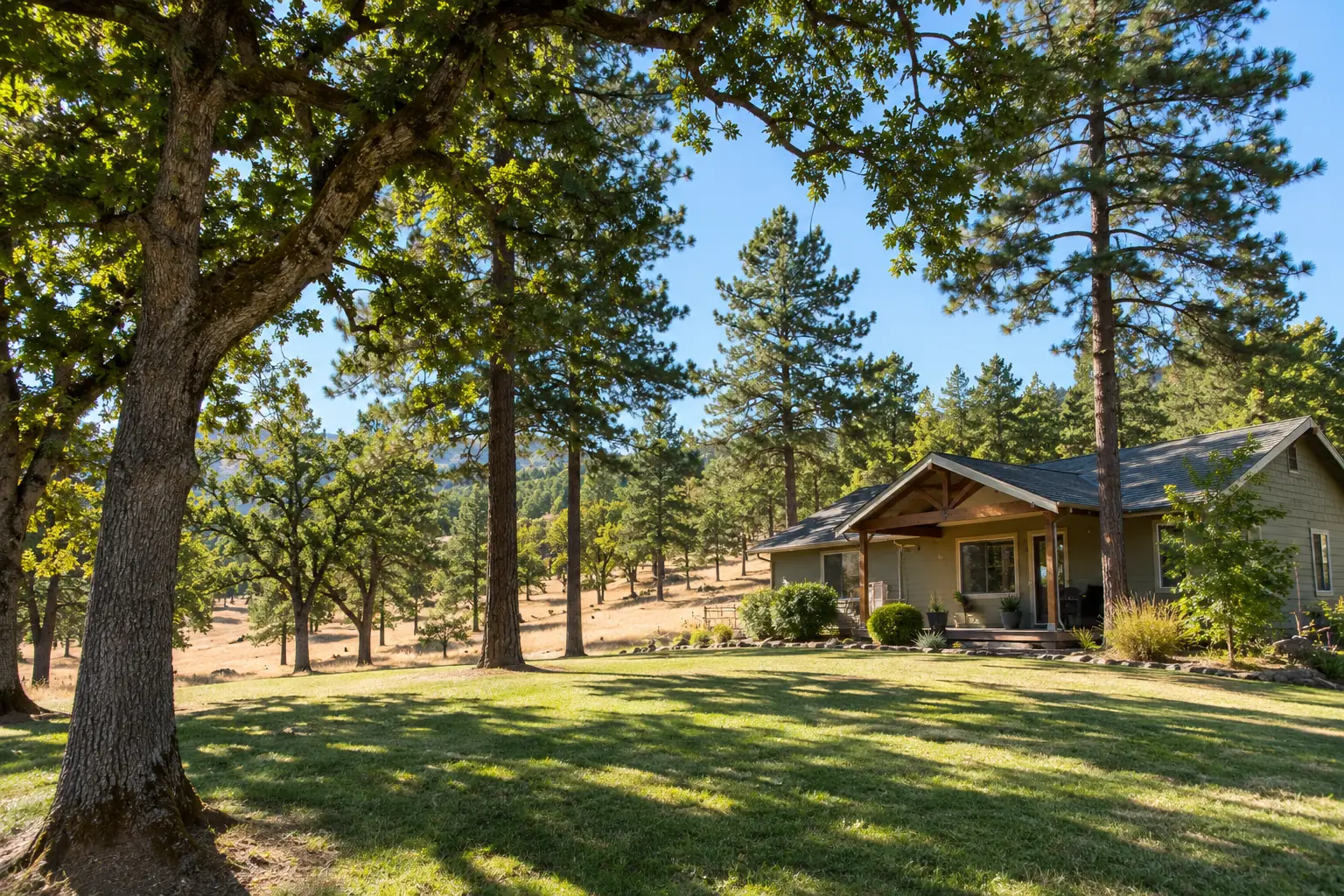
Defensible space is the cleared, managed ground around your home. The Oregon State Fire Marshal splits it into three zones: 0 to 5 feet, 5 to 30 feet and 30 to 100 feet or more. Tree work for it, such as limbing, spacing crowns and removing dead trees, is easiest outside fire season, when power saw limits are off.
This guide covers what the state recommends for trees, the fire season rules that limit saws and mowers, and how to time the work. Tree Removal Medford is a free referral service, not a tree company or a fire agency. It connects callers with an independent, CCB-licensed local tree company that can do the cutting. More about the line is on the home page.
The three defensible space zones
The Oregon State Fire Marshal's defensible space page divides the area around a home into three zones:
| Zone | Distance from the home |
|---|---|
| Immediate | 0 to 5 feet |
| Intermediate | 5 to 30 feet |
| Extended | 30 to 100 feet or more |
For trees, the same page gives two simple rules: space tree crowns at least 10 feet apart, and prune trees up 6 feet from the ground. It also says to remove leaves, needles and debris from the roof and gutters.
The first five feet
The immediate zone is the strictest. The state's model defensible space code calls for a noncombustible space at least 5 feet wide around buildings, decks and other development. It should be free of combustible vegetation and of piles of needles, leaves, firewood, lumber and bark mulch. Gravel, concrete and bare dirt are allowed.
What the state model code says about trees
The model code gives the most detailed tree rules the state has published. The Oregon State Fire Marshal finalized the code on May 19, 2026, and it is available for voluntary adoption by cities, counties and fire agencies. This guide could not confirm whether Medford or Jackson County has adopted it, so treat it as the state's recommended standard unless your city or county tells you otherwise.
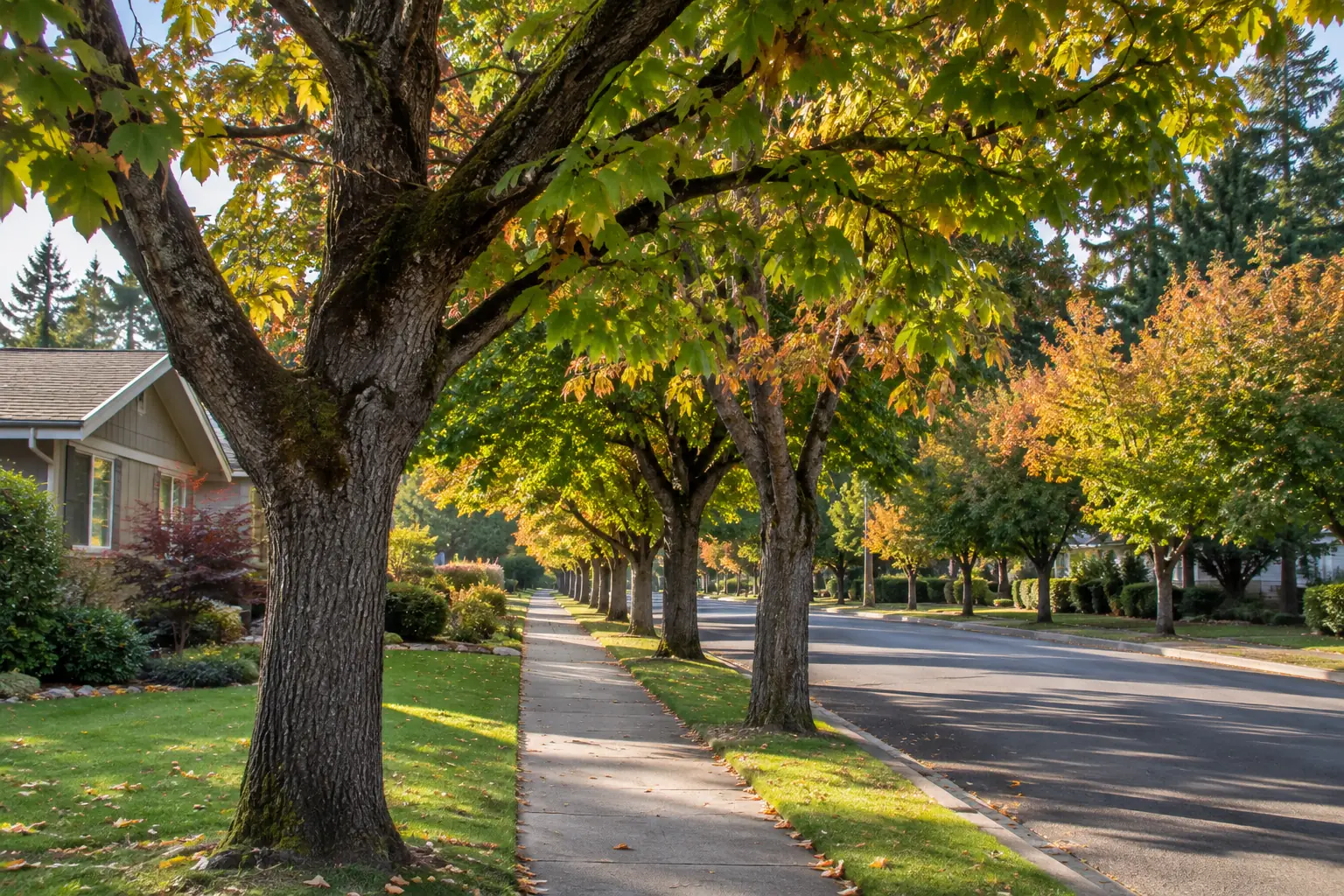
The code's tree sections say:
- Spacing. Well-kept trees are encouraged in defensible space, as long as there are at least 10 feet between the crowns of neighboring trees, and between tree crowns and structures, overhead electrical lines or unmanaged fuel.
- Trees taller than 18 feet. Crowns that reach within 10 feet of a structure should be pruned back to keep 10 feet of clearance. Limbs less than 6 feet off the ground should be removed.
- Trees 18 feet or shorter. Lower limbs should be removed up to one third of the tree's height. Newly planted and young trees are an exception.
- Chimneys. Any part of a crown within 10 feet of a chimney outlet should be pruned to keep 10 feet of clearance.
- Deadwood. Deadwood and ladder fuel should be removed from trees regularly.
The code also sets how far the treated area should extend, based on the hazard level a local government assigns: 30 feet for moderate hazard, 50 feet for high and 100 feet for extreme. Those distances stop at your property line.
Free assessments
You do not have to work this out alone. The Oregon State Fire Marshal offers a free defensible space assessment, which its page describes as an education-focused visit with tips to start or improve your defensible space. Requests go through the assessment link on the Fire Marshal's defensible space page.
OSU Extension also publishes a regional handbook, Before Wildfire Strikes: A Handbook for Homeowners and Communities in Southwest Oregon (EM 9131).
Fire season rules on ODF-protected land
During fire season, the Oregon Department of Forestry limits when power saws can run on the lands it protects, and the limits tighten as fire danger rises. ODF's Southwest Oregon District declared the start of fire season on May 15, 2026, at 12:01 a.m., according to Jackson County Fire District 3.
ODF's regulated closure proclamation for the Southwest Oregon District, effective May 15, 2026, sets these power saw rules:
| Fire danger level | Power saw use |
|---|---|
| Low (green) | Allowed all day |
| Moderate (blue) | Before 1:00 p.m. and after 8:00 p.m. only |
| High (yellow) | Before 10:00 a.m. and after 8:00 p.m. only |
| Extreme (red) | Prohibited |
The proclamation also requires one shovel and one fire extinguisher of at least 8-ounce capacity with each power saw, plus a fire watch of at least one hour after each saw is used. Battery and electric chainsaws are included. Mowing dried, cured grass follows the same schedule, and battery or electric string trimmers are included. Mowing green, irrigated lawns is exempt.
The proclamation covers lands protected by the Southwest Oregon Forest Protection District in its listed regulated use areas, plus forestland within one-eighth of a mile. If you are not sure whether your property is ODF-protected, call ODF's Medford Unit at 541-664-3328, the number Jackson County Fire District 3 lists. The current fire danger level changes through the season, so check it before any saw work. The proclamation also bans backyard debris burning throughout fire season, which matters when you are deciding what to do with branches.
Tree companies have their own set of rules. ODF uses Industrial Fire Precaution Levels for commercial operations, and Jackson County Fire District 3 notes that a fire watch is required under Level I unless waived. The company you hire is responsible for following the rules that apply to its work.
When to schedule defensible space tree work
The simplest plan is to do the big cutting outside fire season or while the danger level is low. That gives the crew full working days instead of a few cool morning hours, and it avoids the risk of a saw spark in dry grass. HomeGuide's national cost guide also says winter and early spring are often cheaper for tree work because demand is lower, while summer and fall prices can run 10% to 20% higher. The tree removal cost guide has the full price ranges.
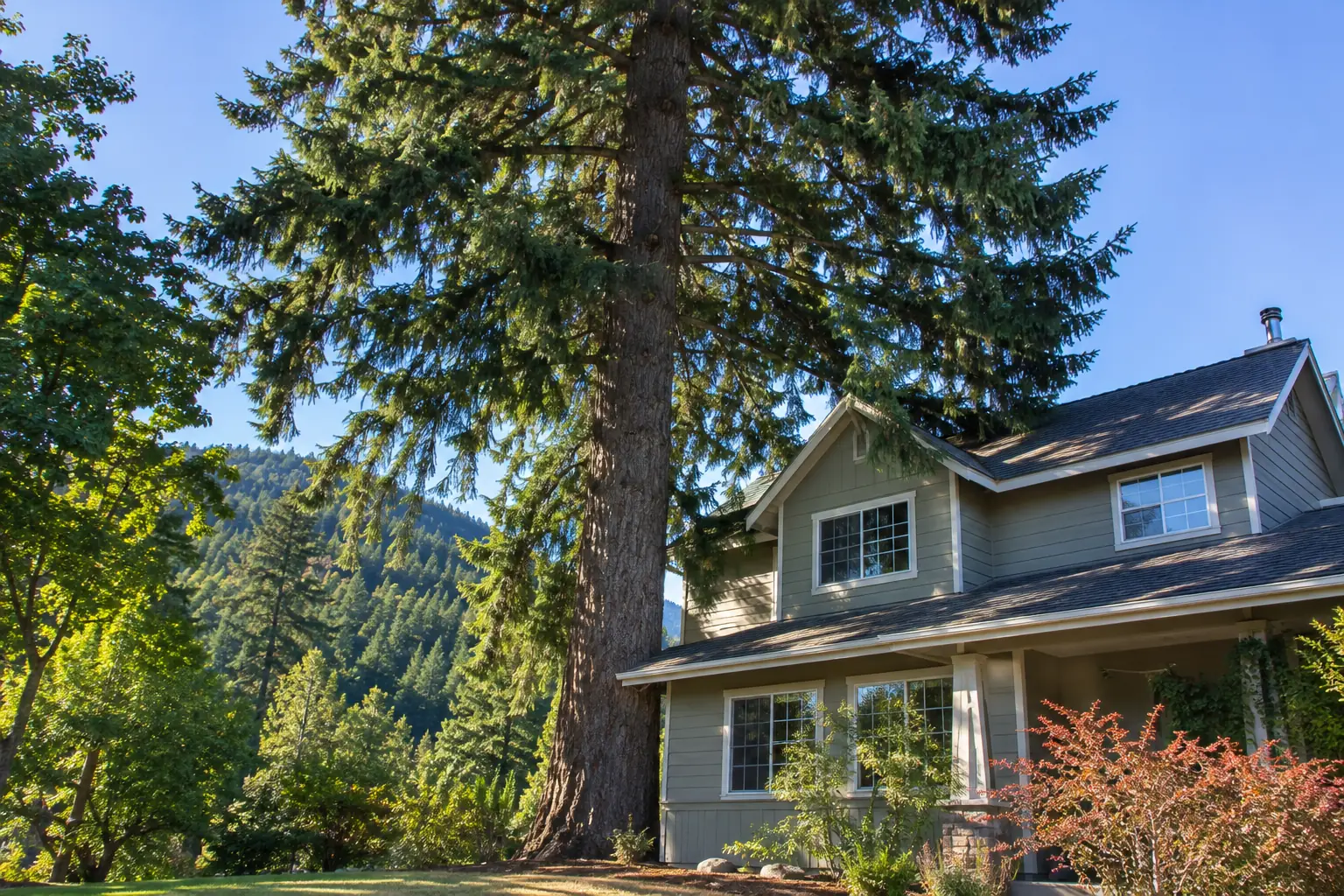
A practical order of work:
- Have the tree work done first: dead trees down, crowns spaced, lower limbs pruned, limbs cleared back from the roof and chimney.
- Have the wood chipped or hauled off rather than piled. A brush pile next to the house is fuel, and burning it is banned during fire season.
- Clear the first 5 feet around the house and decks.
- Keep up with needles and leaves on the roof and in the gutters through the summer.
If something urgent comes up during fire season, such as a tree that fell in a storm or a dead limb over the roof, the company can tell you what it is allowed to do under the current danger level.
Dead trees and Douglas-fir decline
Dead trees close to the house are a priority for both fire and falling reasons. OSU Extension's January 2025 summary of Douglas-fir decline research says dead and fallen trees raise wildfire risk, especially where annual rainfall is under 35 inches. Many firs on dry sites around the Rogue Valley are dying from drought stress and the flatheaded fir borer. The hazard tree warning signs guide lists the symptoms to look for, and the hazard tree removal page explains the removal side.
Firewise USA for neighborhoods
Firewise USA lets a whole neighborhood work on wildfire risk together. The National Fire Protection Association's Firewise USA program is co-sponsored by the USDA Forest Service and the National Association of State Foresters. Neighbors form a committee, get a wildfire risk assessment, write a multi-year action plan and complete risk reduction work each year. The NFPA says Firewise sites are recognized, not certified, and neither are the homes inside them.
Trees near power lines
Do not prune near power lines yourself, even for defensible space. The model code wants 10 feet between tree crowns and overhead electrical lines, but that work belongs to the utility or to crews trained for it. Pacific Power runs its own vegetation program and offers a free temporary disconnect when tree work needs access near your service line. The trees near power lines guide explains who to call.
What the tree company can do
The company you are connected with can handle the cutting part of defensible space. That can include removing dead or dying trees, thinning crowns to open up spacing, pruning lower limbs, clearing limbs back from the roof and chimney, and chipping or hauling the wood. Ask the company how it handles fire season rules and when it can schedule the work.
To reach a licensed local tree company about fire clearing, call (541) 200-0074. Ask on that call whether an estimate costs anything. For routine clearing work it usually does not. Ask the company for its CCB number, and check it on the Oregon CCB license search.
Frequently asked questions
What are the defensible space zones in Oregon?
The Oregon State Fire Marshal uses three zones: the immediate zone from 0 to 5 feet, the intermediate zone from 5 to 30 feet and the extended zone from 30 to 100 feet or more. The first 5 feet should be noncombustible, and trees farther out should be spaced with crowns at least 10 feet apart and pruned up 6 feet from the ground.
How far apart should trees be for defensible space?
The Fire Marshal's page says to space tree crowns at least 10 feet apart and prune trees up 6 feet from the ground. The state model code also calls for 10 feet between crowns and structures or overhead power lines, and 10 feet of clearance around chimney outlets.
Can I use a chainsaw during fire season in Jackson County?
On ODF-protected land, it depends on the fire danger level. ODF's 2026 Southwest Oregon proclamation allows power saws all day at low danger, before 1 p.m. and after 8 p.m. at moderate, before 10 a.m. and after 8 p.m. at high, and not at all at extreme. Each saw needs a shovel, an 8-ounce or larger extinguisher and a one-hour fire watch.
Do the power saw rules apply to battery chainsaws?
ODF's 2026 regulated closure proclamation for the Southwest Oregon District says battery and electric powered chainsaws are included in the power saw restrictions, so the same hours and equipment rules apply.
Is the state defensible space code required in Medford?
The Oregon State Fire Marshal says the model code finalized in May 2026 is available for voluntary adoption by cities, counties and fire agencies. This guide could not confirm whether Medford or Jackson County has adopted it. Check with the city or your fire agency.
When is the best time to do fire clearing tree work?
The easiest time is outside fire season, or when fire danger is low, so saws can run all day. Winter and early spring are also slower months for tree companies, and HomeGuide's cost guide says prices are often lower then.